
It used to be that home theater was the signature system of the technology integration market. That was then however, and today the market is driven by lighting technologies, including fixtures, lighting control and shades.
Given the obvious differences between the home theater and lighting categories, it would be easy to say these solutions have nothing in common. As the saying goes, “au contraire,” as both home theater and lighting systems can suffer from problems related to low-quality power.
Some of the problems poor power can introduce to a home include the limiting of system performance and system life. Conversely, the investment in clean power enables products and systems reach their performance threshold, while extending product life.
Clean Power Points of Interest:
- A study finds the U.S. lighting category is expected to grow from almost $7 billion in 2025 to more than $19 billion by 2032.
- Modern home electronics are vulnerable to issues related to poor or inconsistent power
- Modern home systems utilize microprocessors that are sensitive to fluctuations in electrical power
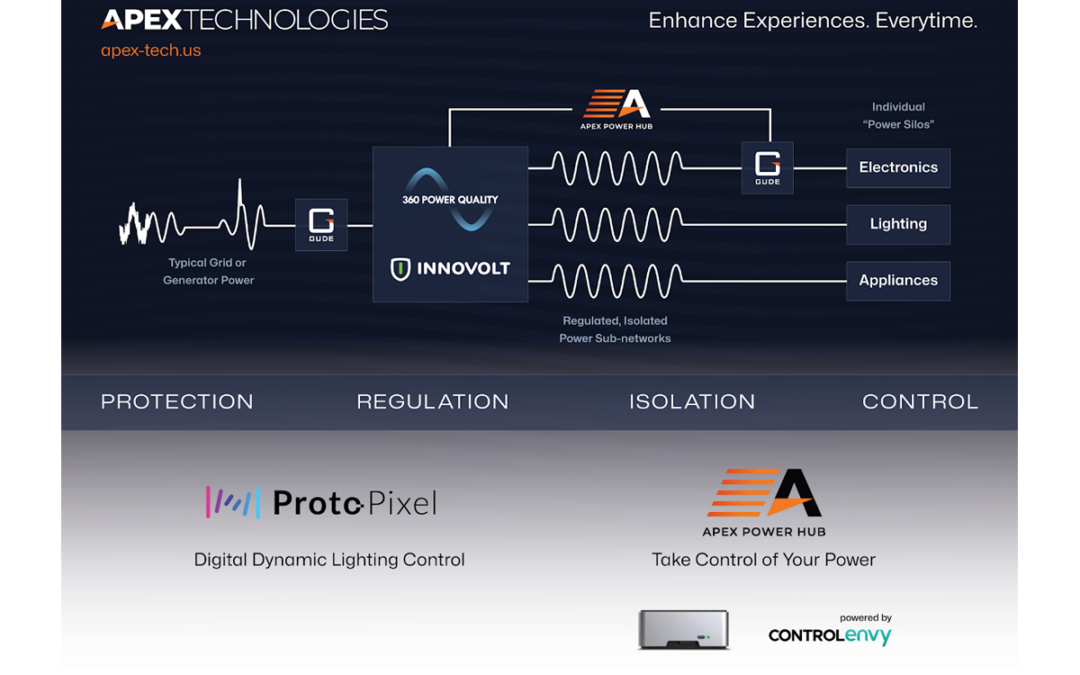
- Apex Technologies US’ four-point approach to clean power: Protection, regulation, isolation, and control
- The investment into quality power is small compared to the investment in premium lighting fixtures and other components
Why Clean Power Matters
For those that believe lighting is only a fad or trend, let’s reassess that opinion. Lighting is not going away. On a global level, a study from MarketsandMarkets states the lighting category is expected to grow from $9.86 billion in 2025 to more than $17 billion by 2030.
In the U.S., research from Data Bridge Market Research estimates the lighting category will grow from about $6.80 billion in 2025 to just over $19 billion in 2032.
To protect the investments homeowners are making in these new, advanced lighting products and systems, Vince Luciani, power products specialist, Apex Technologies US, emphasizes that clean, consistent power is the best way to protect and enhance these solutions.
Looking at the recent history of the lighting market and its evolution, Luciani notes that at one time, lighting systems were not complicated. Modern lighting systems he says have evolved and those complexities make these solutions more vulnerable to power issues.
“Lighting used to be simple: Power flowed through a switch directly to a light fixture. The system was reliable, tolerant of power disturbances, and could last for decades,” comments Luciani.
“Today’s lighting systems are far more complex. LED fixtures are often powered by centralized drivers and controlled through touchscreens, voice assistants, sensors, and automation systems. Commands pass through multiple processors and data networks creating many more potential points of failure than traditional switched lighting.”
Because modern LED lighting systems utilize sophisticated drivers and control processors, some of the issues dirty or inconsistent power can cause include voltage fluctuations such as voltage sags, brownouts, and voltage swells, as well as sustained over voltages, surges, and harmonics. Additionally, low-quality power can cause EMI/RFI noise that causes flickering fixtures, and it can produce unsavory elements like color inconsistencies, random reboots, and communication failures.
Unfortunately, says Luciani, when these problems do develop, homeowners fault the lighting products and systems.
“Many homeowners blame the lighting system when the actual culprit is unstable power,” he points out.
“In reality, the most advanced lighting products are often the most sensitive to power quality issues. Incandescent bulbs were very forgiving and covered up the same power disturbances that have always been present.”
Power is Critical in Modern Homes
To combat low-quality power Luciani recommends a four-step approach: Protection, regulation, isolation, and control.
Luciani admits that there are several means to address clean power that are already popular in technology integration industry, but the above suggested four-step method to power augments these solutions to make them more comprehensive. Adding voltage regulation and isolation to whole-home and point-of-use surge protection can keep voltages consistent and isolate products from cross contamination.
Supporting the four-step approach that Luciani outlines, he advises that dealers should continue to specify IP addressable control products to help solve problems that aren’t power related.
“The benefits [of the four-step approach] are immediate and long-term,” underscores Luciani.
“Lighting systems operate more consistently, dimming performance improves, flicker is minimized; communication reliability increases, and equipment life is extended.”
Getting back to the point of the commonalities that home theater and lighting share, Luciani reiterates the same power issues that affect systems such as AV and networks, also impact lighting.
As homes become increasingly connected, he continues, the reliability of every subsystem within the home depend on the electrical foundation of these homes.
“Clean power is no longer an audio/video luxury—it has become a whole-home infrastructure requirement,” stresses Luciani.
“Log onto a customer’s router and count how many IP addresses are being used. Each one of these devices—in addition to many others in the home—contain a microprocessor that is susceptible to power quality issues that can disrupt daily life if they malfunction.”
Analyzing the investment into clean power he adds pales when compared to the costs of other components within a smart home and that investment protects all the systems within the home.
“When compared to the cost of premium lighting fixtures, centralized drivers, control processors, programming and labor, the investment in proper power protection is relatively small, yet it protects every component in the system,” asserts Luciani.
“The better question is whether it makes sense to invest heavily in sophisticated technology without protection the power source that everything depends upon. Clean power improves reliability, extends equipment life, reduces maintenance costs, and helps homeowners get the full value from their lighting investment.”
To learn more about Apex Technologies US and its product lines, as well as other KMB Communications’ clients, check out this link here.