
After spending a week in Denver for CEDIA Expo 2026 and talking with technology integrators, manufacturers, builders and other professionals working across the residential market, one thing became abundantly clear: The conversation around home technology is maturing.
It’s becoming less about the latest shiny object and much more about infrastructure, reliability, performance, and how well all this stuff actually works together once the homeowner moves in.
That matters for custom builders. CEDIA’s new research estimates the U.S. professional residential technology market at $33.8 billion, with home networking alone accounting for 15% of the market. Meanwhile, NAHB reports that 52% of builders expect artificial intelligence to positively affect housing and the industry over the next decade, while 61% identify energy costs as a long-term concern.
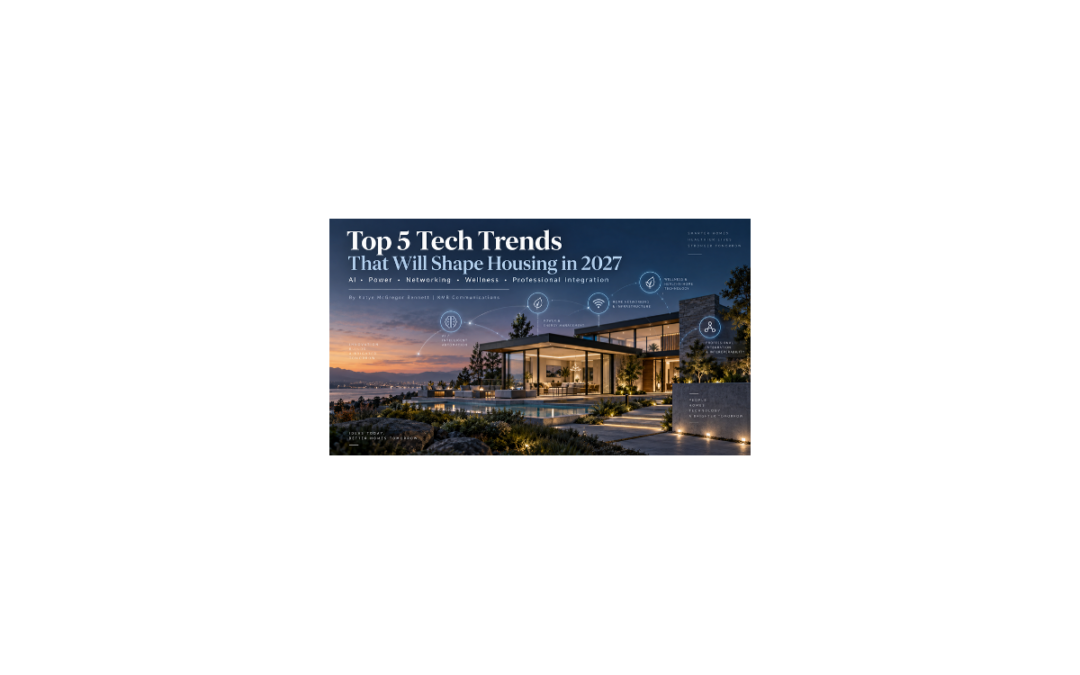
So, looking ahead to 2027, here are five home technology trends I believe deserve builders’ attention:
1. AI Will Fade into the Background
This is actually a good thing. The most valuable AI in a home probably won’t require homeowners to think about AI at all. It will help systems anticipate needs, simplify routines, identify issues, and operate more efficiently. CEDIA Expo’s 2026 education program included roughly 20 sessions specifically focused on AI, with an emphasis on practical applications and predictive smart-home technologies.
The builder takeaway? Don’t try to predict the next AI gadget. Create the infrastructure and project coordination that allow the home to evolve.
2. Power Moves into the Planning Conversation
More of the home depends on electricity than ever before. Everything in the home from climate systems and lighting to networks, security, EV charging and automation all require power.
The problem is that reliability isn’t guaranteed. U.S. electricity customers averaged 11 hours of interruptions in 2024, nearly twice the annual average of the preceding decade, according to the U.S. Energy Information Administration. Telehealth, home healthcare, living in place, and an aging population needing in-home care are gaining more awareness and compounding the impact of poor power quality and reliability rapidly. In addition, homes are more commonly featuring EV charging, battery storage, solar, automation, and more electrically dependent systems.
Therefore, expect greater attention to power quality and reliability, electrical capacity, backup power, load management, surge protection, and energy monitoring earlier in the building process.
3. The Network Becomes Home Infrastructure
Wireless does not mean infrastructure-free. I will happily keep saying this until everyone stops looking surprised. A high-performance connected home depends on a properly designed network, wired backbone, thoughtfully placed access points, carefully chosen equipment locations, and pathways that allow the system to change over time.
The Home Technology Association (HTA) makes a related point in its space-planning guidance for residential technology: Equipment rooms require more than enough space for a rack. Electrical circuits, ventilation or cooling, structured cable pathways, network distribution, and future service access all need to be considered during design.
In other words, the network is no longer merely supporting the technology. Increasingly, the network—and the infrastructure around it—are part of the home itself.
4. Wellness Gets More Measurable
Healthy-home conversations are also becoming more tangible. The EPA reports that people spend about 90% of their time indoors, where some pollutant levels may be several times higher than outside.
Indoor-air-quality sensors, ventilation, filtration, humidity control, intelligent lighting, and automated shading give builders and homeowners more ways to monitor—and increasingly respond to the indoor environment.
5. Professional Integration Matters More
Wrapping up this list of home technology trends is professional integration. As the number of connected systems increases, successful projects depend less on any single product and more on how everything works together.
CEDIA recommends selecting smart-home ecosystems based on project and client needs rather than assuming there is one universally “best” platform. Professional systems can integrate lighting, climate, security, entertainment, and other technologies while supporting scalability, updates, and ongoing service.
Emerging standards such as Matter are worth watching, but in sophisticated custom homes, proven system architecture, a robust network and experienced technology integration remain the foundation.
Just as important is when that expertise enters the project. HTA’s Project Technology Assessment guidance for builders and construction professionals recommends determining the client’s technology needs before framing, electrical, and HVAC bids are obtained so the integrator’s electrical, cooling, and framing requirements can be incorporated accurately—helping reduce change orders and delays.
That may be the most important home technology trend of all.
The future isn’t necessarily about putting more technology into homes. It’s about planning technology more effectively.
On October 1 at 3:00 p.m. ET, I’ll moderate NAHB’s “What’s Next in Home Technology: Insights from the 2026 CEDIA Expo” webinar with custom builder Greg Hardwick and residential technology experts Bret Jacob and Sean Weiner. We’ll dig into what builders and remodelers should know now about the technologies shaping the homes they’ll be delivering next.
Because the easiest time to plan for tomorrow’s technology is still before somebody installs the drywall.
Katye McGregor Bennett is the CEO and Founder of KMB Communications. To learn more about these trends or to simply ask a question, email Katye at katye@kmbcomm.com