by Bob Archer | Oct 28, 2026 | Apex Technologies, News
Case study: Nerve Pinnacle 2 Project
Download images here
Download video here
Photography by Ron Aguilar
Inside Pinnacle 2: Nerve Creates a New Model for the Automated Luxury Home
More than 770 connected devices work as one largely invisible ecosystem, allowing this multi-award-winning residence to respond naturally to the homeowners’ routines and preferences while enhancing wellness, comfort, entertainment and everyday living.
In a home encompassing 18,000 square feet, 167 architecturally complex windows, a recreation wing with a bowling alley and basketball court, extensive outdoor living spaces, a wellness-focused primary suite and a reference-grade private cinema, technology could easily become overwhelming. At Pinnacle 2, it does exactly the opposite.
The multi-award-winning project by Utah-based integration firm Nerve shows what can happen when technology is treated as an architectural asset from the beginning rather than equipment added after construction. More than 770 connected smart devices and systems spanning approximately 120 equipment categories work together throughout the residence, yet much of the technology remains virtually invisible. So well aligned with the homeowners’ routines and personal preferences, their presence is subtle but has a huge impact on comfort, well-being, and enjoyment.
This balance between extraordinary technological scope and architectural restraint was intentional. Nerve joined the project during the design phase and worked alongside the architect, interior designer, lighting designer, builder, structural engineers, and specialty trades. The homeowners wanted exceptional entertainment, personalized comfort and wellness, but they also wanted the home to respond naturally to their lifestyle without requiring constant interaction with touchpanels, apps, or keypads.
The result is less a collection of automated subsystems than a single responsive environment. “The goal was never to fill this house with technology. It was to create a home where technology quietly supports the way the family wants to live. With a project of this scale, the real measure of success is whether hundreds of devices can work together without the homeowner ever having to think about what’s happening behind the scenes,” says Todd Astill, president of Nerve.
One Platform, Hundreds of Technologies
Crestron Home serves as the technological foundation of Pinnacle 2, coordinating lighting, motorized shading, distributed audio and video, climate, security, networking, landscape lighting, pool and spa equipment, environmental controls and entertainment. At the core are Crestron CP4-R and MC4-R processors, with DM NVX AV-over-IP video distribution, DM NAX audio distribution, QMT motorized shading, Horizon keypads, touchpanels and handheld remotes. The platform also integrates technologies from Araknis, Netgear, Tekmar, DoorBird, Yale, Jandy, Future Automation, Apex, WattBox, SurgeX and numerous entertainment manufacturers. But the scale of the integration is only part of the story. More significant is how those technologies interact.
Automation routines respond to daylight conditions, occupancy, astronomical schedules and homeowner preferences. Exterior daylight sensors coordinate lighting and shades. Driveway sensors trigger exterior illumination as vehicles approach. Pool features, landscape lighting, music and water features can be combined into entertainment scenes. Within the primary suite, lighting changes throughout the day to support the homeowners’ routines and circadian rhythms. Consequently, much of the home’s technology operates without anyone consciously controlling it.
Opening 167 Windows of Automation Possibilities
Nowhere is the collaboration between architecture and technology more evident than the shading system. Pinnacle 2 contains 167 windows of varying sizes and configurations, including curved, canted, and trapezoidal openings as well as expansive walls of glass. Many are surrounded by steel, glass and tongue-and-groove ceiling treatments, leaving little tolerance for conventional shading hardware.
Rather than compromise the architecture with jamb-mounted shades, Nerve worked with the project’s architect, structural engineer, interior designer and lighting designer to integrate custom recessed shade pockets directly into ceilings and structural elements. More than 130 individually engineered roller, coupled and dual-shade assemblies incorporate multiple designer fabrics with varying openness factors and blackout capabilities. The system manages privacy, glare, daylight and solar heat gain while preserving the views that were fundamental to the architectural concept.
All of the shades operate according to environmental conditions and programmed routines, with manual control available whenever desired. This is a recurring theme throughout Pinnacle 2: some of the project’s most sophisticated engineering exists specifically so the homeowners don’t have to think about it.
Next Level Lighting Checks All the Boxes
The lighting design adapts effortlessly, as well. Working with a dedicated lighting designer, Nerve integrated small-aperture fixtures, trimless details, tunable white illumination, daylight sensors and automation into an architectural lighting plan intended to complement rather than compete with the home’s contemporary aesthetic.
In the primary suite, Crestron Circadian Lighting combines tunable white fixtures with exterior daylight sensing, astronomical scheduling and automated shading. Color temperature, intensity and natural daylight are coordinated throughout the day to support the homeowners’ sleep and wake cycles while maintaining comfort and views. Schedules can also be adjusted for travel, seasonal changes and evolving routines.
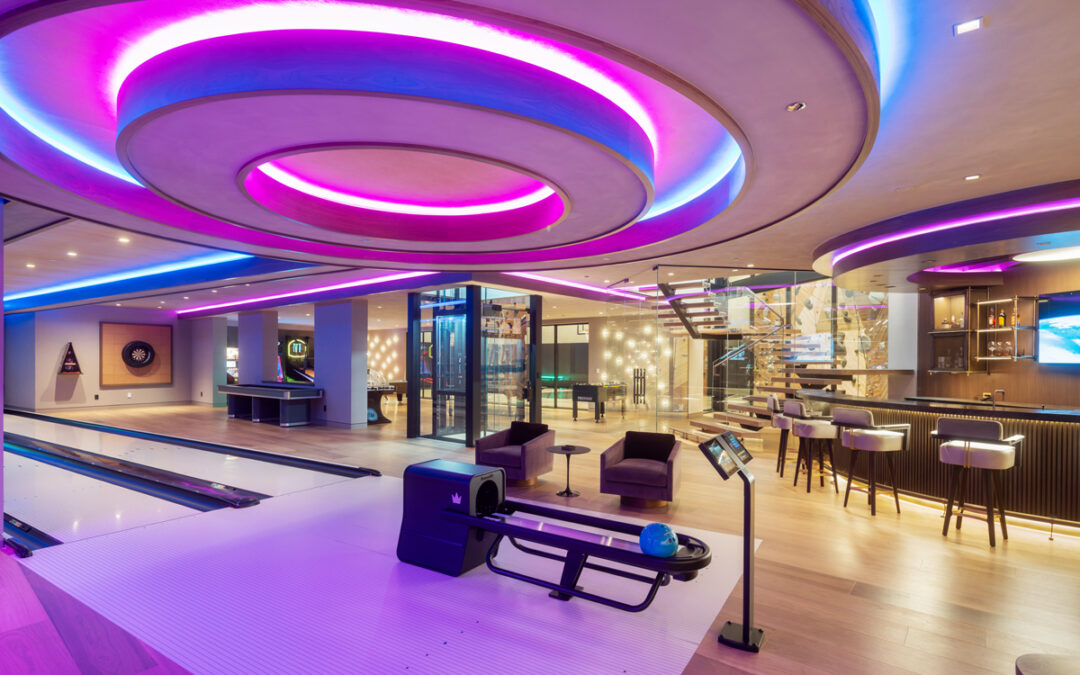
Elsewhere, in the home’s expansive recreation wing, which includes a bowling alley, arcade, basketball court, climbing wall and entertainment areas, lighting becomes more theatrical. Here, dynamic RGB lighting transforms each area with customized scenes designed around different activities, celebrations and occasions. Patriotic themes, retro-inspired palettes and other personalized settings can completely alter the atmosphere in seconds.
Landscape illumination, pool and spa lighting, motorized shades and water features extend those choreographed experiences outdoors, allowing the architecture and surrounding environment to change together as the day progresses or the homeowners entertain guests.
Suite Technologies Support Better Health and Wellness
The primary suite provides perhaps the clearest example of technology supporting an experience rather than calling attention to itself. Far more than a bedroom, the suite encompasses a sitting room, two offices, two bathrooms, a fitness room and sauna, with an outdoor connection created through a bridge and water feature. Lighting, shading, entertainment, climate and automation had to function across these interconnected spaces as a single personalized environment.
Architectural lighting creates visual pathways through the suite while circadian lighting adjusts color temperature and intensity throughout the day. Automated solar and blackout shades balance daylight, privacy, thermal comfort, and room darkening. Integrating those shades was particularly challenging because the motors and fabrics had to disappear into the tongue-and-groove ceilings. Recessed pockets were therefore coordinated with the architect, designer and builder well before installation.
Discreet loudspeakers, hidden infrastructure and carefully integrated displays further preserve the visual character of the space. A ceiling-mounted display, personalized interfaces and automated pathways give the homeowners access to technology when they want it while allowing most everyday functions to occur in the background.
Getting Personal with Keypad Designs
For a home this technologically sophisticated, the design of the user interfaces was critical. Nerve deliberately avoided making touchscreens the center of the experience. Instead, automation handles many repetitive functions while physical controls remain immediately available for intentional changes. Even those controls became part of the interior design, though.
“We spent a tremendous amount of time thinking about how the homeowners would actually experience the system,” Astill says. “The automation handles many of the everyday functions in the background, but when they want to interact with the home, everything is personalized to them—from the keypad finishes and labeling to their favorite scenes and entertainment settings. The objective was to make a system involving hundreds of devices feel personal rather than a mundane technical exercise.”
Crestron Horizon keypads feature premium glass and metal finishes selected to complement the home’s materials. Custom engraving includes personalized room terminology, French nomenclature and playful scene names, including a “Strike” command in the bowling alley.
The personalization extends to entertainment. Cooking, party and relaxation modes can call up favorite music while coordinating lighting and other environmental elements. Outdoor scenes similarly combine landscape lighting, pool and spa controls, water features and motorized covers.
Elevated Entertainment of Unprecedented Engineering
Music and video drift throughout Pinnacle 2, supported by a robust network and distributed infrastructure. The residence incorporates 174 discreet architectural loudspeakers along with Samsung, Sony and LG displays, while Crestron’s DM NVX and DM NAX platforms handle video and audio distribution. Araknis networking and Netgear AV switches provide the underlying connectivity, with SurgeX, WattBox and Apex equipment supporting power management and remote monitoring.
Entertainment becomes particularly experiential in the recreation areas. The bowling lane incorporates a video wall, while other specialty environments include the arcade, basketball court, climbing wall and a custom golf simulator.
Yet one space pushes the project’s entertainment ambitions considerably further. Located beneath the motor court and surrounded by active living areas, the private cinema presented a formidable acoustic and structural challenge before its specifications became even more ambitious. During construction, the homeowners experienced Nerve’s reference cinema and decided to elevate the Pinnacle 2 theater accordingly. The redesigned room ultimately incorporated a Christie Griffyn commercial projector, 300-inch wall-to-wall curved screen, an ASCENDO 11.6.8 immersive audio system with dual 32-inch infrasonic subwoofers, Trinnov Altitude processing, Q-SYS bass management, Lumagen video processing, Kaleidescape, and D-BOX motion seating.
Accommodating those upgrades required rethinking the room itself. Nerve collaborated with the architect, builder, structural engineers, and specialists including Gerry Lemay of Quest AI, Ted White of The Soundproofing Company, and calibration expert Adam Pelz. A triple-layer isolation envelope was engineered to contain the theater’s enormous acoustic energy. A custom projector hush box incorporates dedicated conditioned air and long-run exhaust, while concealed HVAC pathways preserve both acoustic performance and aesthetics.
The 300-inch screen created another challenge: maintaining proper sightlines without excessive riser heights. Nerve worked with the seating manufacturer to progressively increase seating height instead, maintaining optimal viewing angles.
Custom wool acoustic fabrics, walnut and brass finishes, hidden loudspeakers and bespoke seating keep the room’s sophisticated engineering discreet, while multiple presets within the Crestron control platform optimize the environment for reference cinema, demonstrations, two-channel music, EDM listening and nighttime viewing.
Technology That Is Felt, Not Seen
Pinnacle 2’s numbers tell one story: 18,000 square feet, more than 770 connected devices, approximately 120 equipment categories, 167 windows, more than 130 custom shade assemblies and 174 architectural loudspeakers. But the experience of living there tells a very different one. For the homeowners, that extraordinary technological complexity largely disappears into the background. Lighting and shading respond automatically to daily routines and changing conditions. Entertainment, climate and outdoor environments adjust intuitively to how each space is being used. Personalized controls put command within easy reach when desired, while carefully orchestrated automation quietly manages much of the home behind the scenes.
“You can look at the equipment list and appreciate the scale of this project, but that’s not what the homeowner should experience,” Astill remarks. “They should experience a home that feels comfortable, personal and effortless. Making all of that complexity disappear is what makes Pinnacle 2 so special.” Ultimately, that may be the greatest achievement of this multi-award-winning project: not how much technology Nerve integrated, but how little the homeowners have to think about it.
Equipment
Automation & Control
- Crestron CP4-R and MC4-R processors
- Crestron Horizon glass and metal keypads
- Crestron touchscreens and TSR-310 handheld remotes
- Crestron DM NVX AV-over-IP distribution
- Crestron DM-NAX distributed audio
- Crestron QMT motorized shading
- Crestron tunable white lighting and daylight sensors
Networking & Infrastructure
- Araknis networking
- Netgear AV switches
- SurgeX power conditioning
- WattBox intelligent power distribution
- Apex Power Management
Audio & Video
- AV Pro Video Wall Controller (Bowling Alley)
- LG, Samsung, and Sony displays
- Origin Acoustics
- Ambisonic Outdoor Audio
- Marantz
- Future Automation mounting systems
- Apple TV
Cinema & Specialty Systems
- Christie Digital Cinema Griffyn 4K35 projector
- Lumagen Radiance Pro video processor
- Severtson borderless screen with Nerve integrated masking system
- Isco XXL anamorphic Lens
- Trinnov Altitude CI processor and amplification
- Qsys Core24f with expansion modules for bass management
- ASCENDO Immersive Audio for Atmos channels, subwoofers, infrasonic subwoofers & amplification
- Quest Acoustic Interiors Acoustic engineering & L.E.N.S treatment system
- Audio & Video Calibration by Adam Pelz of Bespoke Cinemas meeting RP22 standards
- Soundproofing Company IB1 isolation clips & Green Glue
- Jaymar custom theater seating
- Kaleidescape Strato Players & Premier server
- D-BOX motion seating
- Custom Golf Simulator featuring Trackman IO with TPS software & swing analysis cameras
Security & Entry
- DoorBird video intercoms
- Yale smart lock
- Qolsys alarm system
Check out CE Pro’s Podcast episode with Nerve’s Todd Astill where he discusses what it took to complete this installation with editor Zach Comeau.
To read more about the installation, check out CE Pro’s story on this large smart home that features nearly 800 connected devices.
by Bob Archer | Oct 26, 2026 | Leon Speakers, News, SONOS
Technology Design Collective Brings Design-First Technology Talks, Interactive Demonstrations, and Industry Connections to Design Edge Midwest
Featuring CEDIA, Leon Speakers, Mills Technologies, and Sonos, Booth #235 will help interior designers discover new possibilities for their projects—without needing to become technology experts.
SCHAUMBURG, Ill., October 26, 2026 — Great design doesn’t stop at what you see. And technology shouldn’t get in the way of what you’ve envisioned. That’s the thinking behind the Technology Design Collective, a collaborative experience making its appearance at Design Edge Midwest, November 4–5, 2026, at the Renaissance Schaumburg Convention Center in Schaumburg, Illinois.
Located in Booth #235, the Technology Design Collective brings together CEDIA, KMB Communications, Leon Speakers, Mills Technologies, and Sonos to help interior designers better understand how integrated technology can enhance their projects, protect their creative vision, and create exceptional experiences for their clients.
Through approachable education, hands-on product demonstrations, and opportunities to connect directly with technology professionals, the Collective aims to bridge the gap between the interior design and residential technology communities.
“Interior designers shouldn’t have to become technology experts to confidently incorporate technology into their projects,” said Katye McGregor Bennett, founder and CEO of KMB Communications, who is leading the Collective’s programming and activation. “They do, however, benefit tremendously from understanding what’s possible, knowing when to bring technology into the conversation, and having the right partners at the table. We’re creating an environment where designers can ask questions, explore ideas, and build relationships that make their projects and their businesses even stronger.”
Technology Design Collective Talks: Real Conversations, Practical Takeaways. A centerpiece of the experience is a series of five short, engaging Technology Design Collective Talks, offered throughout both show days.
Designed specifically for interior designers, these informal 10–15-minute sessions address familiar challenges, explore emerging opportunities, and provide practical insights that can be applied to real projects. Each Talk will be followed by opportunities for more personalized conversations with participating experts.
The Talk lineup includes:
- Technology Without the Tech Talk
What every designer should know about integrated home technology—and the people who make it work. Led by Andrea Harvey, CEDIA Dir. Of Design-Build Outreach
Demystifying integrated home technology, exploring where it intersects with interior design, and helping designers understand when and how to engage qualified technology partners.
When: Wednesday, Nov. 4, 2026 @ 11:30 a.m.
- “We Don’t Want Tech.” (But the Wi-Fi Better Work!)
Finding the balance between what clients say they want and the technology they can’t live without. Led by Katye McGregor Bennett, KMB Communications
Clients may insist they don’t want a “smart home,” but take away their Wi-Fi, streaming services, or favorite conveniences, and it’s an entirely different conversation. So, what do they really mean when they say they don’t want technology? We’ll explore how to uncover their actual needs, navigate expectations, and create environments where connectivity, convenience, and comfort work beautifully together—without technology taking center stage.
When: Wednesday, Nov. 4, 2026 @ 1:30 p.m.
- Design Stars Reunited – The cameras stopped. The stories didn’t.
The auditions. The drama. The doors that opened. Led by Lee Hershberg
HGTV Design Star contestants Tiffany Brooks, Tylor Devereaux, and Boris Von Hagen, are together again, sharing how they got there, what you didn’t see and where the experience took them.
Location: Technology Design Collective
When: Wednesday, Nov. 4, 2026 @ 3:30 p.m.
- 5 Practical Tips for Incorporating Tech into Your Designs.
Learn how integrating tech can elevate your offering and delight clients. Led by Bryan Mills, Mills Technologies
Practical solutions for integrating displays, speakers, and connected devices while minimizing visual clutter, managing glare, and preserving the designer’s vision.
When: Thursday, Nov. 5, 2026 @ 11:30 a.m.
- Don’t Let the TV Ruin the Aesthetic of the Room!
Clever ways to conceal technology, eliminate distractions, and protect your design aesthetic. Led by Bryan Mills, Mills Technologies
Practical solutions for integrating displays, speakers, and connected devices while minimizing visual clutter, managing glare, and preserving the designer’s vision.
When: Thursday, Nov. 5, 2026 @ 1:30 p.m.
All Talks will take place in the Technology Design Collective, Booth #235. Attendance is open to registered Design Edge Midwest attendees.
Seeing—and Hearing—What’s Possible
Beyond the Talks, designers will find tangible examples of how technology can complement an interior rather than compete with it.
An integrated demonstration wall featuring a Sony BRAVIA television, concealed backbox, articulating mount, and Leon Mera Sound Sconces will illustrate practical ways to reduce visible technology and create a more intentional installation.
Leon Speakers will also showcase design-focused solutions, including a TV frame for a 65-inch Sony BRAVIA display, a Tonecase solution for concealing the Sonos Arc Ultra soundbar, Loom acoustic textile panels, Mera Sound Sconces, and an Ente SoundTile.
Sonos will feature Sonos27 and its range of sound solutions spanning whole-home listening, personal audio, portable speakers, and professionally installed systems. Together, the Leon and Sonos demonstrations will give designers an opportunity to explore the relationship between technology, materials, placement, sound, acoustics, and the overall aesthetic and experience of a space.
CEDIA will bring its perspective as the professional association for the smart home technology industry, while Chicagoland-based integration specialist Mills Technologies will provide practical insight into planning, installation, and collaboration with design professionals.
Bryan Mills, president of Mills Technologies and a frequent educator and speaker for the interior design community, is supporting the Collective’s demonstrations and will be on hand to meet designers, answer questions, and connect with those interested in continued learning or potential collaboration on future projects.
KMB Communications is coordinating and managing the Collective’s educational programming, partner participation, event experience, and supporting communications.
A Special HGTV Design Star Reunion
The Technology Design Collective will also host “Design Stars Reunited — The Cameras Stopped. The Stories Didn’t,” a special gathering and Q&A sessions featuring HGTV Design Star alumni Tiffany Brooks, Tylor Devereaux, and Boris Von Hagen.
Taking place Wednesday, November 4, from 3:30–3:50 p.m., the conversation will revisit their experiences on the show, the opportunities that followed, and the paths their design careers have taken since. The reunion adds another opportunity for designers to connect, share experiences, and be part of the broader design community gathering at Design Edge Midwest.
A Place for Designers to Discover, Connect, and Collaborate
The Technology Design Collective is intended to be more than a product showcase. It’s a place to have the conversations that don’t always happen early enough in a project—and to connect designers with the people, knowledge, and resources that can help them deliver on their vision.
Designers attending Design Edge Midwest are encouraged to stop by Booth #235, attend one or more Talks, experience the demonstrations, and meet the participating organizations.
Event Details
What: Technology Design Collective at Design Edge Midwest
When: November 4–5, 2026
Where: Renaissance Schaumburg Convention Center, Schaumburg, Illinois
Booth: #235
Technology Design Collective: technologydesigncollective.com
Design Edge Midwest: www.designedgeco.com/midwest2026
Attendee Registration: www.prereg.net/2026/designedgemw/index.cfm
About the Technology Design Collective
The Technology Design Collective is a collaborative education and demonstration experience connecting interior designers with the professionals, products, and resources that make integrated home technology more approachable and accessible. Through lively conversations, hands-on experiences, and meaningful industry connections, the Collective helps designers gain confidence, expand creative possibilities, and deliver spaces that are as functional and intuitive as they are beautiful. Learn more at www.technologydesigncollective.com.
Technology Design Collective Media Contact
KMB Communications
Katye McGregor Bennett
Email: kmb@kmbcommunications.com
Phone: 406-446-1283
Media Resources: Event Graphics and Assets

by Bob Archer | Oct 23, 2026 | Blog
It’s Friday, time for KMB Communications’ Tech Week in Review. This week’s AV industry news covers audiophile products, as well as some Apple news. That news comes from eCoustics, The Listening Chair, Yahoo, AV Nation, and LinkedIn.
A summary of the KMB Technology Week in Review for the week of Oct. 19-23:
- Moon 341 Integrated Amplifier Drops the Streaming but Keeps the Muscle for $5,000 (from eCoustics)
- Esoteric Grandioso N1 Streamer/DAC (from The Listening Chair)
- Spotify Cut 50 Million Tracks from Your Recommendations (from Yahoo Tech)
- Apple’s Next HomeView Model Could Have a Robotic Arm (from LinkedIn)
- Amazon Signage Display: 55-Inch All-in-One for $699.99 (from AVNation.tv)
- The Live Nation Empire that Music Fans Hate is at Risk of a Break Up (Yahoo Finance)
OK, before getting into our weekly news roundup, with temperatures falling, the leaves turning color, and the supermarkets displaying Halloween candy next to stuffing and apple pies, there’s no doubt we are in the fall season.
Fall is a great time of year and Halloween is certainly fun. Let’s however, for a moment look at the National Fire Protection Association (NFPA) recommendation not to overlook safety. Security Sales & Integration posted an advisory from the NFPA that states from 2020 to 2024 there was an estimated annual average of 835 home fires that began with decorations.
The NFPA warns people about the possible hazard of decorations and candles to help ensure fun times during a great time of year.
Now, back to the AV industry news.
Spotify Recommendations and Apple Smart Home Reports
About 20 years ago there were many that had concerns about the long-term future of the home audio market.
Those concerns have shown to be unfounded as the popularity of downloads have waned and the emergence of streaming media has taken over. Aided by the return of physical media, the home audio market is experiencing a revival and even the audiophile side of the category has reemerged.
Leading the week in review off is a post from eCoustics on the Moon by Simaudio 341 Integrated Amplifier. The $5,000 integrated amp is a part of the Canadian company’s Compass Collection, according to the story, and it incorporates Simaudio’s MOON Distortion-Cancelling Amplifier (MDCA) technology.
eCoustics adds the integrated amp omits a built-in DAC, and it is rated to produce 100-watts-per-channel into 8 ohms.
Staying with the audiophile theme, The Listening Chair has a product review of the $45,000 Esoteric Grandioso N1 Streamer/DAC. The review points out the streamer/DAC includes a robust build weighing more than 61 pounds, and the streaming portion of the product offers Spotify, Qobuz, Qobuz Connect, TIDAL, and TIDAL Connect. Without spoiling the takeaway from the review, let’s just say, the Grandioso N1 Streamer/DAC was impressive.
Speaking of streaming, Yahoo Tech had an item on Spotify removing 50 million tracks from its recommendations to make them “invisible.” Elaborating, the tracks weren’t removed entirely from the service, they were eliminated from the streaming service’s recommendation algorithm and relabeled “AI-generated slop and spam.”
Yahoo’s story stresses there are two different numbers to take note of from Spotify. The 50 million tracks that were made “invisible” and the more than 75 million tracks that were completely deleted from the service over the course of the past year.
Getting into some smart home KMB Communications Technology Week in Review news, LinkedIn picked up a story from Bloomberg that says Apple is working on a HomeView display that features a larger screen and a robotic arm.
Citing Bloomberg the LinkedIn post notes the first-generation HomeView cannot swivel, but possible newer versions that are under development could include a motorized option that will allow the larger screen to rotate 360 degrees.
Additionally, the reports state, a higher end version could provide voice recognition to rotate towards the user based during voice commands. Release dates for the upcoming generation of HomeView products are estimated to be at some point in either 2027 or 2028.
Amazon Enters All-in-One Digital Signage
Peeking at what is going on in the commercial AV industry, AVNation.tv is reporting on a 55-inch all-in-one digital signage display that costs less than $700 from Amazon.
The story says the 55-inch 4K digital signage display incorporates a media player, and the release of the product marks Amazon’s first all-in-one digital signage product.
Internally, the display features a quad-core system-on-chip (SoC) architecture and Amazon’s Fire OS. The 4K display supports HDR10+ and its networking capabilities include Wi-Fi 6 and Ethernet connectivity options.
KMB’s final AV industry news story of the week comes from Yahoo Finance. Needless to say, that if you’re a person that attends live music events, you’ve probably complained about the laundry list of fees Live Nation and its properties such as Ticketmaster charge.
Yahoo Finance says that after the Trump administration agreed to settle a monopoly case against Live Nation, several states were not satisfied with the Trump administration. These states went on to file suit against Live Nation and recently it was announced those states won a jury verdict stating Live Nation monopolized live events.
The story, which is long and detailed covers the battle small venues face when trying to hold events in areas that include Live Nation properties.
Under the terms of the Trump administration deal the states were not happy with, Yahoo Finance says that Live Nation would have stopped forcing venues to use its services exclusively, but those states found the agreement insufficient.
In more non-AV industry news, one of rock’s greatest albums celebrated its 57th anniversary on Oct. 22. “Led Zeppelin II” was released back in 1969, and its track list includes classic songs such as “Whole Lotta Love,” “What is and What Should Never Be,” “Ramble On,” and “Bring it on Home.”
On his Instagram account, Jimmy Page said, “It began with rehearsals at my home in Pangbourne and ‘Whole Lotta Love’ and ‘What is and What Should Never Be’ were later recorded at London’s Olympic Studio Number 1 with George Chkiantz who engineered the basic tracks and some guitar overdubs. This provided the foundation for the rest of the tracks to be recorded and overdubbed at various studios in America during our forthcoming tour.”
Showing how important Led Zeppelin remains, the band has just allowed one of its most iconic songs to be used for an upcoming Hollywood movie release set for early 2027.
Explore KMB Communications clients

by Bob Archer | Oct 16, 2026 | Blog
It could be said that in many ways, there’s never been a better time to be a music fan. Sure, concert tickets are expensive but given that touring is the biggest revenue source for artists, due to the music industry’s current business model, the price of concert tickets shouldn’t shock anyone.
Getting back to why now is a great time to be a music fan. Music lovers can play physical media formats such as vinyl and CDs; music fans can download digital files, and of course music fans have a plethora of streaming services available for their listening pleasures.
There’s also been a renaissance in the development of home audio components. The technology integration market has its solutions, audiophiles have their products; there’s personal audio products and general consumer products, and there’s home theater.
This week’s KMB Communications’ Technology Week in Review for the week of Oct. 12-16 features an emphasis on audio that includes personal audio, vinyl, and the mighty Led Zeppelin. These items come from eCoustics, AV Nirvana, Residential Systems, CE Pro, LinkedIn, and Yahoo.
KMB Communications Technology Week in Review for Oct. 12-16 summary of news:
- Fosi Audio’s DAP Neo Brings Back the iPod Experience for $80 Without the Streaming Distractions (from eCoustics)
- Rega Aims to be a Gateway Drug for Better Vinyl Playback (from AV Nirvana)
- Pangea Audio Releases 25th Anniversary Record Doctor XI Record Cleaning Machine (from Residential Systems)
- Apple’s Fabled Smart Home Collection is Here, Here’s What Integrators Need to Know (from CE Pro)
- Apple, Meta Make Nice to Bring Muse AI to Mac Computers (from LinkedIn)
- Greta Gerwig Reveals Why Led Zeppelin Allowed “Narnia” to be the First Movie to Use “Stairway to Heaven” (from Yahoo)
The Momentum for Home Audio Keeps Rolling
The first item in this week’s KMB Communications Technology Week in Review comes from eCoustics.
The website is reporting the audio company Fosi Audio has introduced its DAP Neo portable audio player. Carrying a retail cost of $80 the product borrows style elements from a certain digital audio player that was developed in Cupertino back in the early 2000s.
eCoustics notes the player incorporates a Cirrus Logic CS43198 DAC and a choice of microSD storage options depending on which version is purchased.
Moving on from personal audio to vinyl, AV Nirvana, posted a story on the new Rega Replay turntable.
In the story it says the British audio manufacturer calls the turntable an “audiophile gateway drug,” and the product is designed to offer users a high level of playback without the setup hassles that are associated with traditional turntables. According to AV Nirvana’s post, setup takes less than a minute with all that is required is to just to mount the tonearm’s counterbalance weight; then connect the turntable to an amp or phono preamplifier, remove the guard on the phono cartridge’s stylus, and turn on power.
U.S. pricing and availability have not been announced, but AV Nirvana did the U.K. conversion to dollars, and it says that figure lands at about $343.
Staying within the vinyl category, Residential Systems has an item on the 25th Anniversary edition Record Doctor vacuum-cleaning machine, the Record Doctor XI from Pangea Audio.
The $600 record cleaner features a bi-directional motor, swing arm and cleaning strip, just like the product it is replacing, but Pangea Audio says the new cleaner operates with less noise.
Residential Systems points out the anniversary edition record cleaner is offered in a choice of carbon-fiber vinyl and high-gloss black finishes.
Closing out the home technology portion of the KMB Communications Technology Week in Review is a post from CE Pro.
Apple’s press release was picked up across the technology market with both consumer and the B2B (business to business) media outlets running the story. In the case of CE Pro, the publication says that after a long wait and countless rumors, Apple finally introduced its smart home products.
The story says that Apple worked with Schneider Electric and LG Electronics to release a series of indoor/outdoor cameras, smart thermostats, temperature sensors, and a video doorbell/door lock.
CE Pro continues by pointing out that Apple also introduced its HomeView smart home hub that incorporates a 7-inch Liquid Retina display. The hub product is said to support customization with each user getting their own home screen with apps and widgets. The speaker part of the hub supports whole-house audio applications, and the hub also includes Siri AI.
One last part of Apple’s overall announcement is the news concerning a new Apple TV 4K. The new Apple TV utilizes the company’s A19 chip with features such as a dedicated AV1 decoder.
Other Technology News
Continuing the Apple news, LinkedIn states that Apple and Meta have made peace to partner on the new Muse Spark Open AI model for new Mac Studio computers.
The post says the issues between the two companies had resulted in a long-running feud, but, as Alexandr Wang said in the LinkedIn post, which cites Axios, “We’re excited for mommy and daddy to be playing nice again.”
Bringing the KMB tech week in review back around to music for the final news item for this week’s roundup, is an item from Yahoo.
The media giant says that Greta Gerwig, the director for the upcoming movie, “Narnia: The Magician’s Nephew,” explained why the legendary band Led Zeppelin allowed their classic song “Stairway to Heaven” to be used for the film.
Yahoo Entertainment says the band has never allowed the iconic song—which has never been released as a single—to be licensed prior to the new “Narnia” movie.
Gerwig says she consulted with Led Zeppelin vocalist and lyricist Robert Plant and guitar player Jimmy Page. The duo she continues, signed off on the use of the song, and she added that Plant and Page are fans of the author C.S. Lewis who wrote the “Narnia” books.
For news on KMB Communications clients, click this link.
by Bob Archer | Oct 14, 2026 | D-Tools, News
FOR IMMEDIATE RELEASE | [DOWNLOAD IMAGES HERE]
D-Tools and Portal.io Invite Integrators to “Let’s Build Together” at the 2027 D-Tools User Conference in Atlanta
The first user conference since the merger brings Portal, D-Tools Cloud and D-Tools SI users together March 22–24 for hands-on training, peer exchange and a direct voice in the product roadmap.
RENO, Nevada — October 14, 2026 — D-Tools, the integrator business platform for residential, commercial AV and security integrators, today announced the 2027 D-Tools User Conference (DTUC 2027), March 22–24 at the Grand Hyatt Atlanta in Buckhead.
DTUC 2027 is the first user conference since D-Tools and Portal.io joined forces, and its theme, “Let’s Build Together,” is both a milestone and an invitation. About 150 integration business leaders are expected to join users of all three solutions (Portal, D-Tools Cloud and D-Tools System Integrator) for training, education and conversation, and to help shape where the software goes next.
Learn It, Share It, Build It
The conference opens March 22 with a half-day of hands-on training on all three platforms, so new and longtime users alike can sharpen their skills on the software that runs their business.
The two-day main program, March 23–24, includes:
- A State of the Industry address powered by D-Tools data, plus presentations from industry thought leaders
- Integrator panels where small, mid-size and large firms share what’s working
- Peer roundtables for trading practical, process-level ideas with fellow integrators and the D-Tools and Portal teams
- Three education tracks for owners and executives, sales and design teams, and operations and engineering teams
In addition to the hands-on training and roadmap discussions, attendees will benefit from topics focused on operational efficiency such as: faster and more accurate quoting, AI in proposals, selling recurring services, hiring and team building, inventory and procurement, and the sales-to-operations handoff.
A Seat at the Roadmap Table
Attendees will work directly with D-Tools product, support and leadership teams to help shape the product roadmap.
“This is our first chance to stand in front of our whole community as one company,” said G Paul Hess, CEO of D-Tools. “The best software is built with the people who use it every day. We want integrators in the room trading ideas, working side by side with our product and support teams, and telling us what to build next. Let’s build it together.”
Sponsorship and Registration
Limited sponsorship opportunities are available for companies that want to connect with integration business leaders. Leading brands eero and Ring are signed on as Platinum Sponsors, with Sonos and Future Ready Solutions are Gold Sponsors. Interested companies can learn more about sponsorship on the D-Tools website.
Registration is open now at www.d-tools.com/2027-d-tools-user-conference. D-Tools and Portal users of every experience level are encouraged to bring their teams.
About D-Tools, Inc.
D-Tools, Inc. is a leading provider of business management and proposal software for residential, commercial AV and security integrators. Following its merger with Portal.io, the company offers three platforms (D-Tools System Integrator (SI), D-Tools Cloud and Portal) that streamline sales, proposals, design, project management and service for integration professionals. Learn more at www.d-tools.com or follow D-Tools on LinkedIn, Facebook and X.
Media Contacts:
Tim Bigoness, D-Tools | (925) 270-4102 | timb@d-tools.com
Katye McGregor Bennett, KMB Communications | (406) 446-1283 | katye@kmbcomm.com
All products, product names, trademarks, and registrations mentioned are the property of their respective owners. All rights reserved.

